

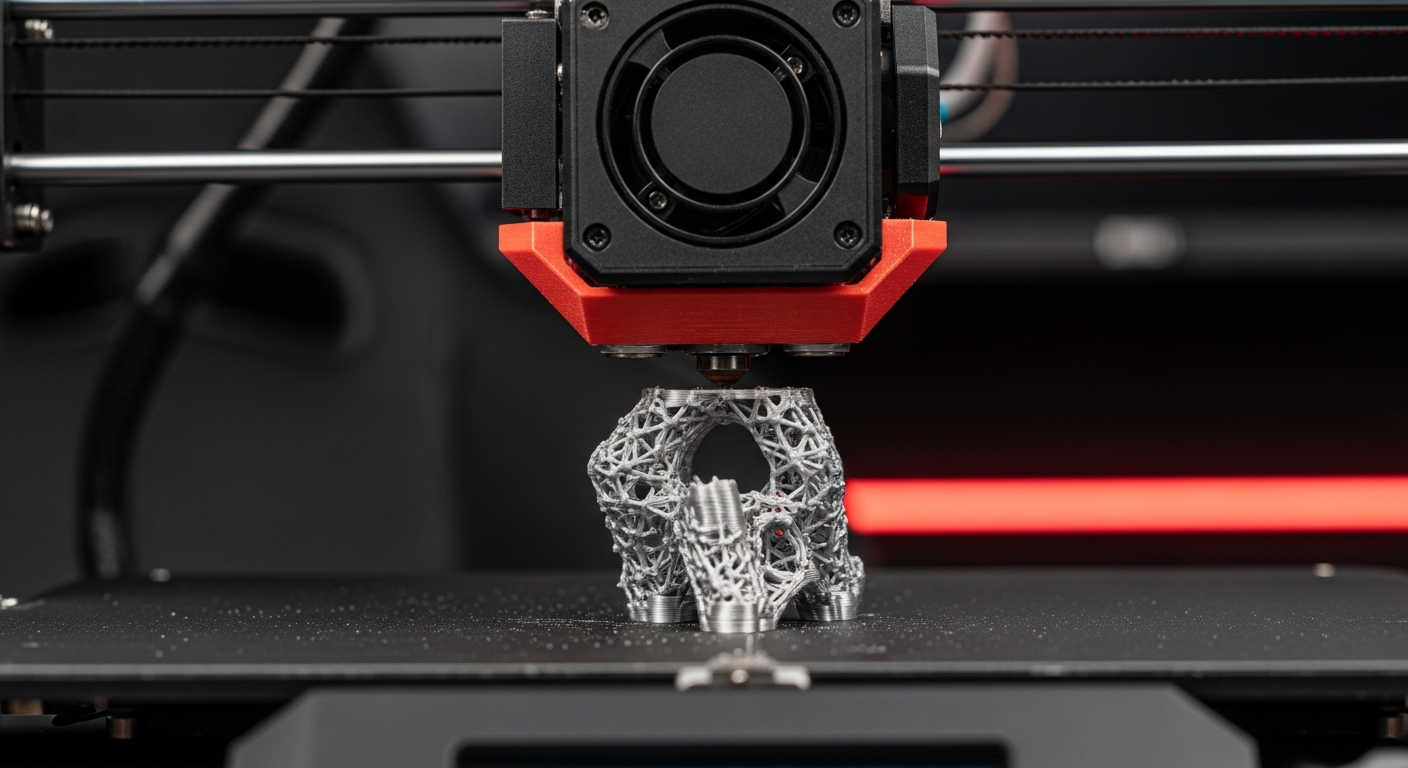
3D printer technology is advancing significantly, with new methods enabling stronger plastic composites through embedded materials and groundbreaking techniques for efficiently printing ultra-hard industrial metals like Tungsten Carbide-Cobalt.
Table of Contents
Once primarily confined to plastic prototypes and hobbyist creations, 3D printers are now at the forefront of material science, creating objects with unprecedented strength, functionality, and industrial utility. This transformative journey is marked by continuous innovation, redefining what's possible in manufacturing.
Reinventing Strength: Beyond Filament
While carbon fiber-infused filaments are often marketed for enhanced strength in 3D prints, actual improvements in mechanical properties frequently demand more sophisticated and strategic reinforcement techniques.
- Filament Limitations:Contrary to popular belief, carbon fiber *filaments* don't always significantly enhance print strength; in some cases, the presence of chopped fibers can even weaken materials like PLA. Their primary benefit often lies in maintaining material integrity at higher temperatures, not general mechanical robustness.
- Subsurface Cloth Reinforcement:True gains in part strength are achieved by embedding long, continuous carbon fiber strands or, more innovatively, by integrating subsurface carbon-fiber cloth between printed layers. This method offers superior structural integrity compared to merely infused filaments.
- Innovative Layered Composites:Researchers like [MagicLAG] demonstrated a novel approach: printing parts in distinct core and shell layers, then precisely epoxying carbon-fiber cloth into the small gap between them. This creates a powerful, integrated composite structure.
- Dramatic Strength Improvements:This 'sandwich' technique with carbon-fiber cloth has been shown to dramatically increase yield strength, with experiments indicating a more than threefold improvement in the load-bearing capacity of test hooks compared to standard 3D prints.
- Strategic Application:For mechanically critical parts requiring maximum strength, consider 3D printing a mold or former and then integrating traditional composite work; this often offers greater control over results and superior final properties than trying to embed fibers during the print process itself.
- Data-Driven Decisions:Always consult comprehensive material data sheets for precise properties, rather than relying solely on marketing claims, especially when selecting advanced filaments for specific performance requirements.
Printing the Unprintable: Ultra-Hard Industrial Metals
The frontiers of 3D printing are expanding rapidly, now enabling the additive manufacturing of materials once considered impossible to process, opening new avenues for high-performance industrial components.
- Tackling Extreme Hardness:Advanced 3D printing technology is successfully working with ultra-hard materials like Tungsten Carbide-Cobalt (WC-Co), a composite highly valued for its exceptional wear resistance and pressure tolerance in demanding industrial applications.
- Overcoming Traditional Challenges:WC-Co has historically been challenging and costly to machine through traditional powder metallurgy, often leading to significant material waste and complex processing steps due to its extreme hardness.
- Precision Laser Cladding:Breakthroughs from institutions like Hiroshima University involve advanced laser cladding techniques, utilizing pre-heated additive wire to carefully soften, rather than completely melt, the WC-Co material.
- Preserving Microstructure:This controlled softening process is crucial as it prevents the destruction of the material's intricate internal structure, which is vital for maintaining its superior mechanical properties and performance.
- Targeted Material Application:The new method allows for the precise application of this expensive, high-performance alloy only to the working surfaces of components, significantly reducing raw material consumption and overall production costs compared to solid-part manufacturing.
- Performance Parity:Experiments have shown that 3D printed WC-Co parts can achieve impressive Vickers hardness values exceeding 1400 HV, comparable to those produced by traditional, more wasteful manufacturing methods, but with vastly improved efficiency.
The Future of Fabrication: Key Considerations
As 3D printing continues to evolve at a breathtaking pace, understanding material science, process nuances, and application-specific benefits is paramount for both enthusiasts and industrial pioneers.
- Beyond Surface-Level Understanding:Always differentiate between truly reinforced composites (e.g., embedded continuous fabric or strands) and merely filled filaments (e.g., chopped fiber mixed in), as the latter may not offer the expected mechanical advantages.
- Application-Specific Material Choice:The optimal 3D printing material depends entirely on the end-use application. For high-temperature resilience, certain CF filaments excel, while for sheer mechanical strength, innovative layering with continuous fibers or cloth is often superior.
- Safety Protocols:When working with advanced materials like carbon fiber, always prioritize safety. Fine carbon fiber particles can pose health risks, similar to asbestos, necessitating proper ventilation and handling precautions.
- The Power of Additive Manufacturing Beyond Direct Parts:3D printers are incredibly valuable for rapidly prototyping molds, jigs, and fixtures for other manufacturing processes, particularly for creating complex components from advanced composites.
- Industrial Efficiency & Cost Savings:The ability to 3D print costly, high-performance materials only where needed—such as for wear surfaces on tools or machinery—marks a significant leap in manufacturing efficiency and cost reduction for specialized industries.
- Continuous Innovation:Stay informed on new techniques and materials. The field is constantly advancing, with research pushing boundaries in strength, durability, and the range of printable substances, from advanced polymers to exotic metals, redefining industrial capabilities.
Frequently Asked Questions
+ How do embedded carbon fibers differ from carbon fiber filament in 3D printing?
Carbon fiber *filaments* typically contain chopped fibers mixed into plastic, which often improves temperature resistance and stiffness but not always mechanical strength. *Embedded* carbon fibers involve continuous strands or fabric strategically placed within layers during or after printing, creating significantly stronger structural composites.
+ Can 3D printers create parts as hard as industrial metals?
Yes, advanced industrial 3D printers can now directly print ultra-hard materials like Tungsten Carbide-Cobalt using specialized techniques such as laser cladding. These methods achieve hardness levels comparable to traditionally manufactured equivalents, ideal for high-wear industrial applications.
Final Thoughts
The journey of 3D printing continues its rapid ascent, pushing boundaries from consumer workshops to heavy industry. Understanding these groundbreaking advancements in materials and techniques is crucial for anyone looking to leverage the full, transformative potential of additive manufacturing in today's world.
Share:
Game On, Pain Off: The Ultimate Guide to Ergonomic Gaming Keyboards for Indian Gamers (2026)
Tech News Update